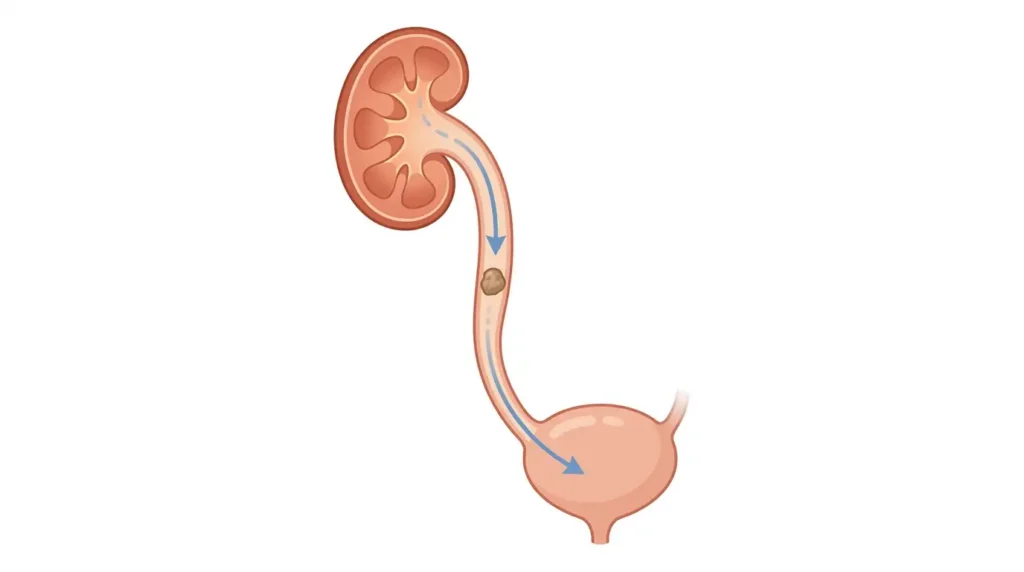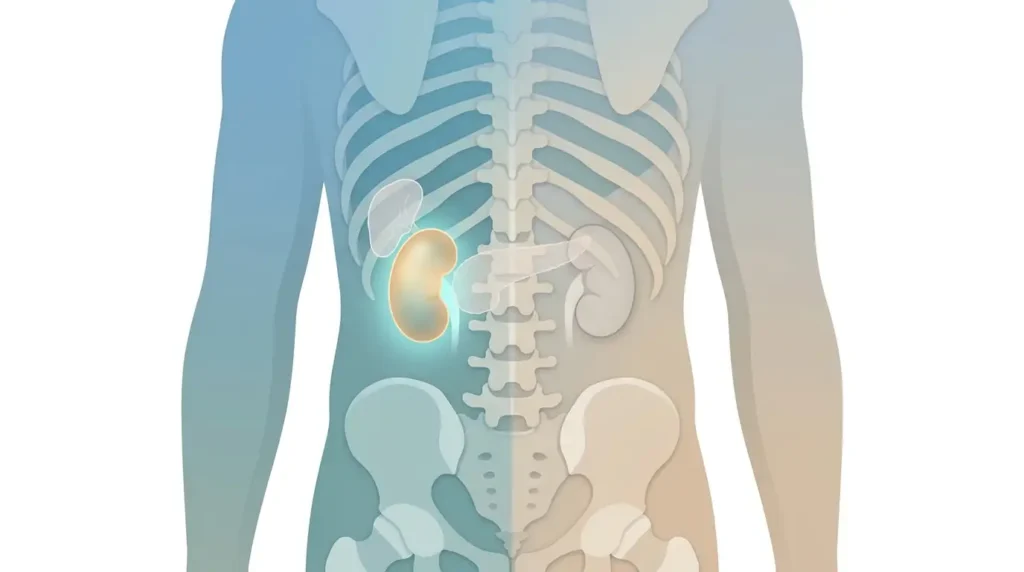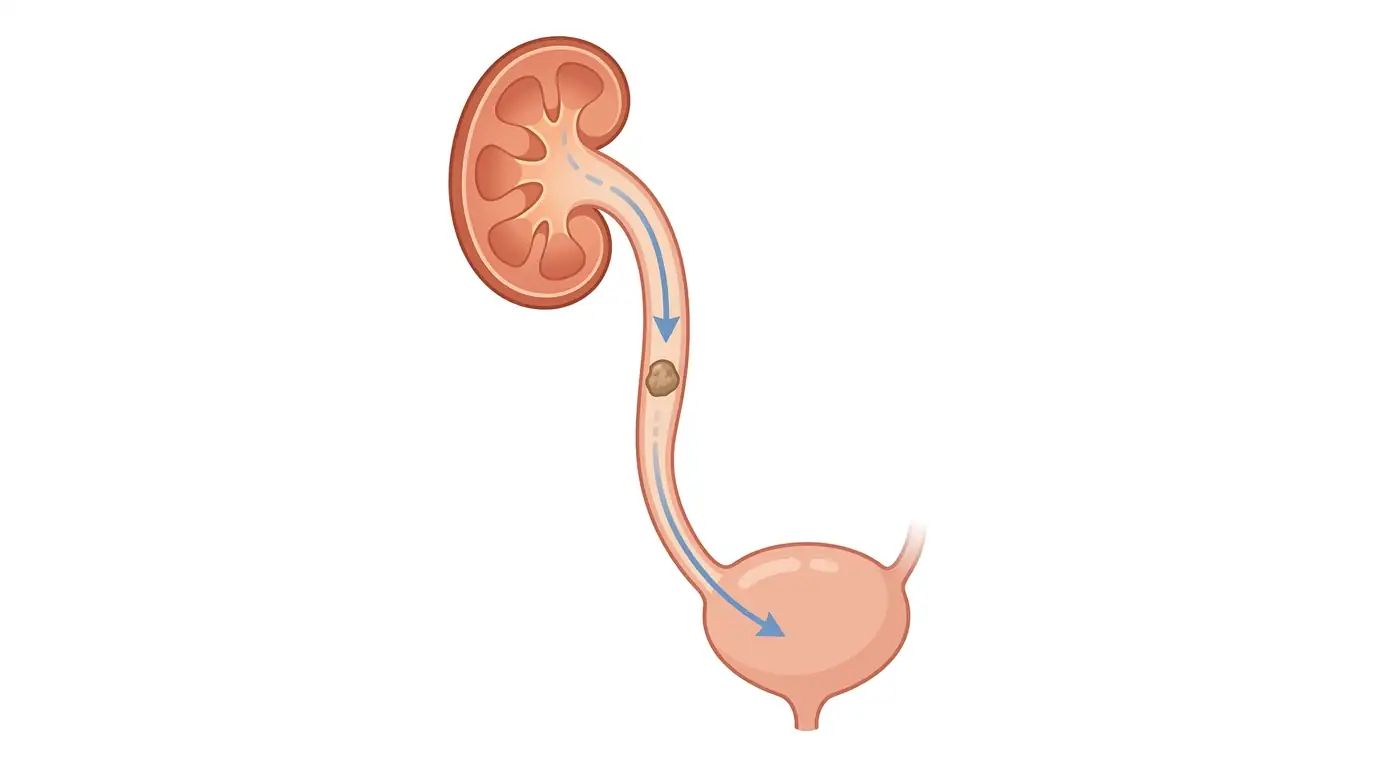
Kidney stone pain usually starts in the flank, the area between your lower ribs and hip on one side, and often moves toward the lower belly and groin as the stone travels down the ureter. Where it hurts can give a clue about where the stone is, but it cannot confirm it.
This guide follows the pain from the kidney to the bladder, explains why it shifts, and shows how to tell which signs need care right away. For what the pain itself is like, see our guide to what kidney stones feel like.
Key Takeaways
- Kidney stone pain usually starts in the side or back below the ribs, on the same side as the stone.
- As a stone moves down the ureter, the pain often shifts toward the lower belly and groin.
- Near the bladder, you may feel a stronger urge to urinate or pain when you urinate.
- A stone that stays in the kidney and does not block urine often causes no pain.
- Pain location is a clue only. Imaging is needed to find the stone.
- Severe pain, fever, chills, or being unable to urinate need emergency care.
Where Does Kidney Stone Pain Usually Start?
Cleveland Clinic describes renal colic, the pain of a stone blocking the urinary tract, as intense flank pain on the affected side, between your lower ribs and hip. It can spread to the back, the groin, or the lower belly. The pain starts on the same side as the stone, so a stone in the right kidney or ureter usually hurts on the right.
A stone sitting quietly inside the kidney often causes no pain at all. The same source notes that a stone that does not block the flow of urine usually will not cause symptoms, even a large one. Pain usually begins when a stone moves into the ureter, the narrow tube that carries urine to the bladder, and blocks the flow.
That is why people often feel fine for months and then have sudden, one-sided pain below the ribs. If your pain started this way, read how kidney stones form in our guide to how you get kidney stones, and see how low fluids play a part in dehydration and kidney pain.
How Does Kidney Stone Pain Move as the Stone Travels?
Harvard Health explains that the location of pain may shift downward, closer to the groin, as a stone travels down the ureter toward the bladder. This table shows the general pattern. Stones vary, and your pain may not follow it exactly.
| Where the stone is | Where you may feel pain | Other clues |
|---|---|---|
| In the kidney, not blocking urine | Often nowhere | May be found by chance on a scan |
| Blocking the kidney’s exit or the upper ureter | One side of the back or flank, under the ribs | Nausea, vomiting, and blood in the urine can come with it |
| Moving down the ureter | The flank pain shifts toward the lower belly and groin on the same side | Pain may come and go in waves |
| Close to the bladder | Lower belly and groin, with pressure | A stronger urge to urinate, and pain when you urinate |
The Cleveland Clinic lists nausea, vomiting, pain when you urinate, and fever among the other symptoms that can come with stone pain. If any of those appear, tell your doctor.
Why Does the Pain Show Up Away From the Kidney?
The pain does not come from the stone itself as much as from the blockage it causes. When a stone gets stuck in the ureter, urine backs up and the kidney swells. The kidney is not a stretchy organ, and swelling irritates the nerves on its surface, which sends pain signals to the side and back.
The kidney, ureter, and bladder share nerve pathways with the lower belly and groin. As the stone moves, the part of the tract that is stretched or irritated changes, and so does the area where you feel the pain. This is also why a stone can be mistaken for appendicitis, a muscle strain, or a gynecologic problem.
Which Side Will Kidney Stone Pain Be On?
Most people feel stone pain on one side, the same side as the stone. A right-sided stone causes right-sided pain, and a left-sided stone causes left-sided pain. Pain on both sides at once is less typical and needs a medical check, because it can point to stones on both sides or to a different problem.
One-sided pain does not always mean a stone. Our guides to right kidney pain and left kidney pain cover the other common causes, including infection and blockage. To see why the two sides can feel different, read about left kidney vs right kidney.
How Can You Tell Stone Pain From Back Pain or a Kidney Infection?
Stone pain often arrives suddenly, sits below the ribs on one side, and shifts toward the groin. Muscle strain usually stays in one spot and changes with movement. A kidney infection usually brings fever and chills along with flank pain, and stones and infection can occur together.
- Pain that moves toward the groin points more toward a stone than a muscle problem.
- Pain that changes when you bend, twist, or press on the spot points more toward the muscles or spine.
- Fever, chills, and cloudy or foul-smelling urine point toward infection, which can happen with a stone.
For a closer comparison, see our guides on kidney pain vs back pain and kidney stones vs kidney infection. If you are unsure what the first warning signs are, read about the first signs of kidney stones.
Which Doctor Should You See for Stone Pain?
Start with your primary care clinician or urgent care, who can order a urine test and imaging to confirm a stone. Stones that need to be removed or broken up are usually handled by a urologist, while a nephrologist helps if stones keep coming back or your kidney function is affected. Our guide to nephrologist vs urologist explains who does what.
Imaging, usually an ultrasound or a CT scan, shows the size and position of a stone. Pain location alone cannot do that, so do not try to guess your stone’s position from where it hurts.
When Is Kidney Stone Pain an Emergency?
Cleveland Clinic advises getting emergency care for severe pain or signs of infection. Do not wait for an appointment if you have:
- Severe pain that does not ease, or pain that comes with repeated vomiting
- Fever or chills with flank or belly pain
- Being unable to urinate, or passing very little urine
- Blood clots in the urine, or confusion or fainting
Go to the emergency room or call 911. A stone that blocks urine, especially with infection, can damage the kidney and needs same-day care.
Talk to ANC About Kidney Stones
If you have had one-sided flank pain, blood in your urine, or repeated stones, our team can review your symptoms and test results and help you plan the next step. Call 651-772-6251 or contact our team online.
Frequently Asked Questions
Where do kidney stones hurt?
Kidney stone pain usually starts in the side or back below the ribs, on the same side as the stone. It often moves toward the lower belly and groin as the stone travels down the ureter.
Can a kidney stone cause groin pain?
Yes. As a stone moves down the ureter toward the bladder, the pain often shifts downward toward the groin. Near the bladder you may also feel a stronger urge to urinate.
Do kidney stones hurt in the front or the back?
Either. Stone pain can be felt in the lower back, the side, or the belly, and it often spreads from the back toward the front as the stone moves.
Can I tell where my kidney stone is from where it hurts?
Pain location is a clue, not proof. Only imaging such as an ultrasound or CT scan can show the size and position of a stone.
When should I go to the ER for kidney stone pain?
Go to the emergency room for severe pain, fever or chills, repeated vomiting, or being unable to urinate. These can be signs of a blocked or infected kidney.
Sources
Medical Disclaimer
This article is for general educational purposes only and is not a substitute for professional medical advice, diagnosis, or treatment. Always consult a qualified healthcare provider with questions about your specific care and treatment options. If you think you may be having a medical emergency, call 911.